Transmit/receive link
The transmitter that sends information and the receiver that accepts it are configured together. The roles of restoring the original information and judging the reception result are placed within the link.
EZIS TECHNOLOGY
EZIS addresses the delivery path of sensor and communication information. Instead of passing a received signal through as is, it is designed to decide whether the information is valid and, based on that decision, to restore it, hold it, or exclude it from the output.
01 / THE PROBLEM
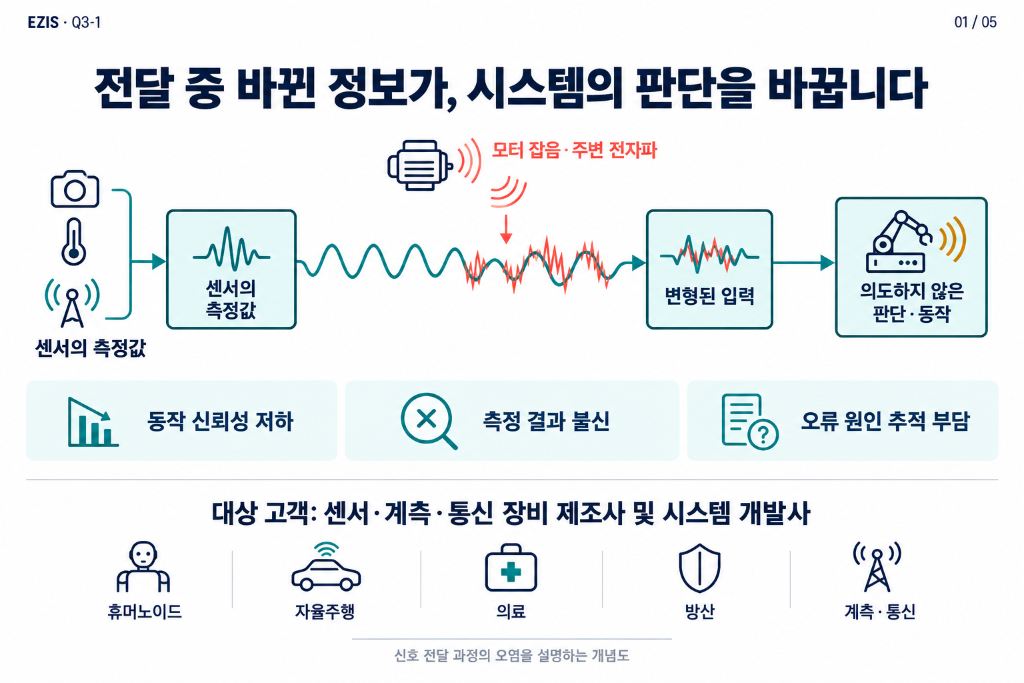
Information measured by a sensor travels through a link to data acquisition units and control systems. If noise and interference affect this path, information that differs from the original measurement can be passed on to the next stage.
The problem is not only that noise exists. If corrupted information is accepted as normal input, it can affect analysis results and equipment decisions. EZIS addresses the reliability of this delivery path.
02 / DIFFERENT ROLES
Shielding, grounding and filtering are important protective measures that reduce interference coupling and unwanted signal components. Error detection checks for changes in information within a defined check coverage.
However, if a value was corrupted before the check information was generated, subsequent checks may not be able to detect that change. EZIS is being developed to work alongside existing protective measures, addressing whether the delivered information is valid.
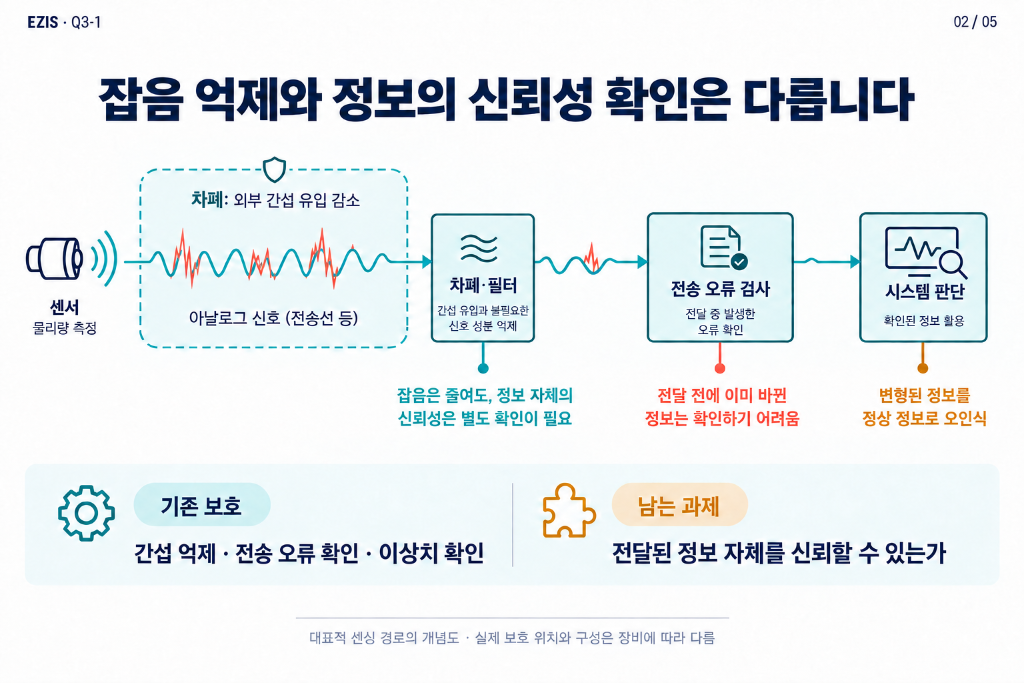
| Role | Primary problem addressed | Points to review together with EZIS |
|---|---|---|
| Shielding, grounding, filtering | Suppressing interference coupling and unwanted signal components | Effect of residual disturbance on reception results |
| Error detection | Detecting errors based on check information and rules | Check coverage and where check information is generated |
| by SOOMBEES | Decision on and restoration of information in the transmit/receive process | Decision conditions, output policy, interfacing with customer equipment |
03 / RESTORE & REGENERATE
The transmitter that sends information and the receiver that accepts it are configured together. The roles of restoring the original information and judging the reception result are placed within the link.
The receiver examines whether information can be confirmed from a noisy received signal. When the conditions are met, the restored information is passed on for downstream systems to use.
An output signal is newly generated from information decided as valid. This is distinct from passing the received waveform straight through.
A segment that may be affected by noise and interference
Output path separated according to validity
New output generated from the restored information
Conceptual explanation from the customer's functional perspective. It does not include the internal encoding scheme, observation structure or decision conditions.
04 / THREE STATES
Reception results are handled as valid, hold or invalid. Rather than simply outputting a single value, the core function is to indicate how each result should be treated.
Restore and deliver the information
The result satisfies the defined decision conditions. Valid information is designed to be restored, regenerated and passed to the next stage.
Secure an opportunity to re-check
The state cannot be confirmed from the current result alone. We are evaluating flows that re-check through repeated observation or retransmission.
Excluded from normal output
The result cannot be used as valid information. It is distinguished from normal results so that downstream equipment can respond according to the state.
Whether to retain the previous value, re-check, or stop the equipment in the hold or invalid state is determined by the operational requirements of the customer's system.
05 / RECOVERY
When new information is received after an interval that was difficult to decide, the result is decided again. Evaluation covers not only whether normal information is restored, but also how long hold and invalid states persist and whether normal reception resumes.
06 / HARDWARE
So that customer software
does not have to run the EZIS internal decision computation
itself.
The core observation, decision and restoration functions are implemented as circuits. Downstream software can use the EZIS decision results and output states in line with the system's operating policy.
This does not mean that the link method and state handling of existing equipment are automatically compatible. Power, I/O, response requirements and the scope of software integration are confirmed for each application environment.
07 / CUSTOMER VALUE
The goal is to make use of information that can be restored in noisy environments, while identifying uncertain results.
Decision logic and output policy are evaluated together to reduce the risk of incorrect input carrying over into subsequent analysis and control.
We aim for an architecture that keeps the core decision in hardware and clearly defines the role of customer software and the scope of integration.
08 / DEVELOPMENT & EVALUATION
Development is under way using models/simulation and FPGA boards. Applying the technology to customer equipment requires separate evaluation under actual input, wiring and disturbance conditions.
Functions are confirmed by comparing decision and output results for the same input.
Results are evaluated against signal characteristics, installation environment, disturbance and response requirements.
Specifications are refined by confirming repeatability, environmental variation, equipment-to-equipment variation and output policy.
This page does not guarantee error blocking under all disturbances, field performance, or completed certification or mass production. Applicability is evaluated including the conditions under which decisions change and the remaining constraints.